Quick Answer: Water your willow leaf ficus bonsai when the top 0.5–1 inch of soil feels nearly dry — never on a fixed schedule. In summer, that may mean daily or even twice daily; indoors in winter, every 3–7 days. Thanks to its riparian origins, Ficus salicaria tolerates consistently moist soil better than most bonsai species, making it relatively forgiving for beginners who use a fast-draining inorganic mix.
Willow leaf ficus bonsai watering is the single skill that will make or break this tree in your care. Get it right and Ficus salicaria rewards you with vigorous growth, dense ramification, and gorgeous fluted bark. Get it wrong — in either direction — and you’ll be staring at a pile of dropped leaves wondering what happened. The good news: this species is more moisture-tolerant than most bonsai, and once you understand its rhythms, it’s genuinely hard to fail.
Willow Leaf Ficus Bonsai Watering: The Complete Guide
The Core Watering Rule
Check the top 0.5–1 inch (1.5–2.5 cm) of soil with your finger before every watering session. If it’s approaching dryness, water thoroughly. If it still feels moist, wait and check again tomorrow. No calendar, no schedule, no app required.
The ideal moisture level is what experienced growers call the “wrung-out sponge” zone: evenly damp throughout the root ball, no standing water, and plenty of oxygen at the roots. Ficus salicaria leans toward the moist end of that spectrum compared to junipers or pines, but waterlogged soil will still rot its roots.
Seasonal Watering Frequency
| Season | Typical Frequency |
|---|---|
| Summer (outdoor) | Daily to twice daily |
| Spring / Fall | Every 1–2 days |
| Winter (indoors) | Every 3–7 days |
These are starting points, not rules. A small pot in a terracotta container on a hot patio dries out far faster than a large glazed ceramic pot kept indoors. Always let the soil — not the calendar — make the call.
How to Water: Step-by-Step Technique
- Use a fine-rose watering can or a hose with a gentle breaker head.
- Water slowly and evenly across the entire soil surface.
- Continue until water flows freely from all drainage holes — this ensures full saturation and flushes accumulated mineral salts.
- Let the pot drain completely. Never leave it sitting in standing water for more than 30 minutes.
- Mist the foliage lightly after watering. Ficus salicaria appreciates foliar moisture, and it actively deters spider mites.
Best Water Quality and Temperature
Soft, slightly acidic water at pH 6.0–6.5 is ideal. Rainwater is the gold standard; filtered water is a close second. If you use tap water, let it sit overnight to off-gas chlorine, or run it through a carbon filter. Hard water with high calcium content will gradually raise soil pH and leave white mineral deposits on the pot and foliage. Always use room-temperature water — anything below 50°F (10°C) can shock tropical roots.
Signs of Overwatering and How to Fix It
- Yellowing leaves starting with the older, lower foliage
- Green leaves dropping while still plump and healthy-looking
- Soil staying wet for more than 3–4 days between waterings
- Musty or sour odor from the soil surface
- Fungus gnats hovering around the pot
- Algae or moss spreading across the soil surface
If you catch it early, simply let the soil dry more thoroughly between waterings and confirm drainage holes aren’t blocked. If root rot is suspected — mushy dark roots, sour soil smell — unpot the tree, cut away all affected roots with clean scissors, soak the root ball in a diluted hydrogen peroxide solution (1 part 3% peroxide to 4 parts water) for 10 minutes, and repot in fresh, fast-draining mix.
Signs of Underwatering and How to Recover
- Leaves curling inward along their length — usually the first visible sign
- Crispy brown tips and margins
- Soil visibly pulling away from the pot edges
- Pot feels very light when lifted
- Sudden mass leaf drop
For mild underwatering, water thoroughly and immediately. For severely dehydrated soil — where the akadama has become hydrophobic and water beads off the surface — submerge the entire pot in a bucket of room-temperature water for 10–15 minutes until bubbles stop rising. Hold off on fertilizing until the tree shows clear signs of recovery.
Species Background: What Native Habitat Tells Us About Watering
Botanical Names and Common Synonyms
The willow leaf ficus goes by several names: Ficus salicaria, Ficus nerifolia, and Ficus salicifolia all refer to the same plant. Ficus salicaria is the name most widely accepted in the bonsai community today, though you’ll still see the others on tags at specialty nurseries. It belongs to the Moraceae family — the figs and mulberries — and is sometimes sold under the common names narrowleaf fig or willow fig.
Native Habitat
In the wild, this species colonizes riverbanks, stream edges, and moist forest margins throughout Central America, the Caribbean, and parts of South America. It has naturalized in Florida and Hawaii. That context matters: a tree that evolved with its roots near moving water expects consistent moisture and does not appreciate long dry spells. This riparian heritage also means it tolerates brief overwatering far better than desert-adapted species — provided your soil drains fast. The soil mix is your safety net.
Leaf and Trunk Characteristics
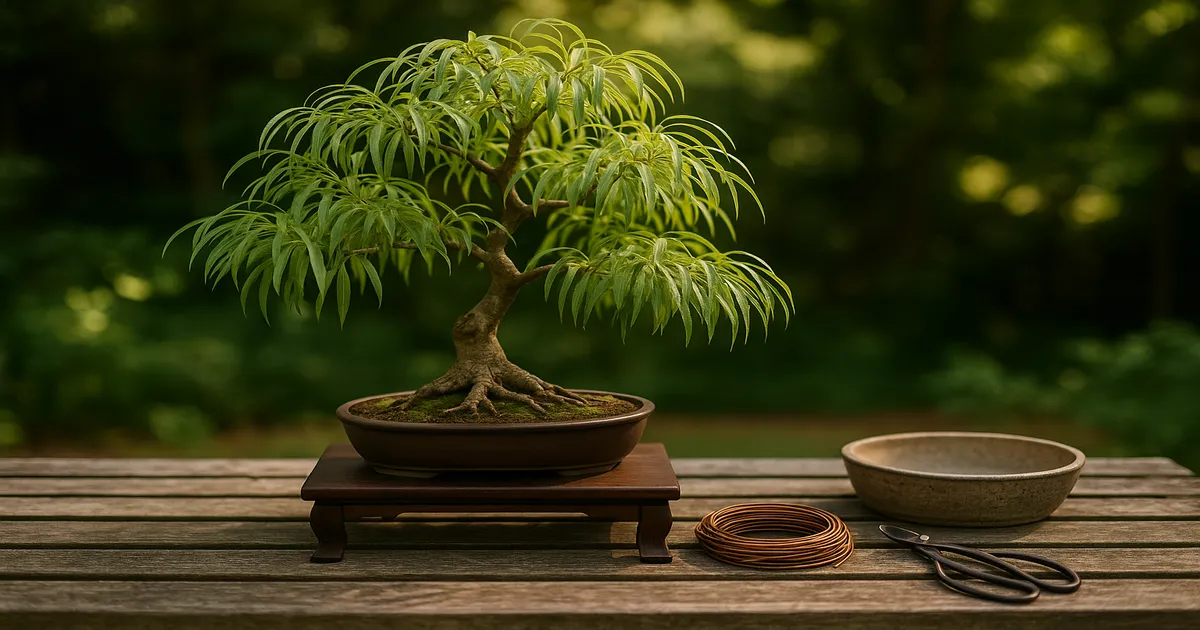
The leaves are narrow and lance-shaped — 2–4 inches (5–10 cm) long and roughly a quarter-inch wide — giving the tree its willow-like silhouette. With consistent training, those leaves reduce further, creating refined, naturalistic canopies. Mature specimens develop attractive gray-to-tan fluted bark, and the species readily forms aerial roots in high humidity, making it ideal for banyan-style compositions.
One shopping note: Ficus salicaria is frequently confused at nurseries with Ficus benjamina ‘Exotica’, which has noticeably broader leaves. Check the leaf width before you buy. The ‘Too Little’ cultivar produces slightly smaller internodes and is particularly prized for shohin and mame work.
Light, Temperature, and Humidity
Light Requirements
Outdoors, aim for 5,000–10,000 foot-candles — partial to full sun with gradual acclimation. Indoors, you need at least 2,000–5,000 foot-candles, which means the brightest south- or west-facing window you have. Below roughly 1,000 foot-candles, growth stalls, leaves yellow, and pest pressure increases sharply.
If your windows can’t deliver adequate light, supplemental grow lights are necessary, not optional. A full-spectrum LED or T5 fluorescent fixture running 14–16 hours per day, positioned 6–12 inches (15–30 cm) from the canopy, will keep the tree healthy through winter.
Temperature and Cold Tolerance
The sweet spot for active growth is 65–95°F (18–35°C). Indoors, 65–80°F (18–27°C) keeps the tree comfortable year-round. Foliage damage begins at 35–40°F (2–4°C), and temperatures below 32°F (0°C) can kill the roots. This is strictly a USDA Zones 10–12 outdoor tree; in Zone 9 and below, it needs winter protection indoors.
Keep it away from heating vents, radiators, and air conditioning units. Temperature swings greater than 15–20°F (8–11°C) trigger the ficus’s notorious stress response: sudden, dramatic leaf drop.
Humidity and How to Increase It Indoors
Ficus salicaria thrives at 50–70% relative humidity. Below 30–40%, expect browning leaf edges and a spike in spider mite activity. Outdoors in summer this is rarely an issue, but indoor winters can be brutal.
Effective methods to raise humidity:
- Room humidifier placed near the tree — the most effective option
- Humidity tray filled with pebbles and water, with the pot resting above the waterline
- Grouping plants together to create a shared humid microclimate
- Foliage misting 2–3 times daily in very dry conditions — helpful, but not sufficient on its own
More light and heat means faster water loss and more frequent watering. Less light indoors in winter means slower growth, slower water use, and a much higher overwatering risk. Adjust your habits whenever you move the tree or as seasons change.
The Ideal Soil Mix
Standard Bonsai Soil Recipe
The three-component inorganic mix is the gold standard for Ficus salicaria:
- Standard outdoor mix: 40% akadama / 30% pumice / 30% lava rock
- Indoor / low-humidity mix: 50% akadama / 30% pumice / 20% lava rock (slightly higher moisture retention compensates for dry indoor air)
- High-humidity outdoor mix (Florida, Hawaii): 25% akadama / 40% pumice / 35% lava rock (prioritizes drainage to prevent root rot in persistently moist conditions)
Use medium-grade particles (3–6 mm) for all components. Akadama holds moderate moisture and provides cation exchange for nutrients; pumice keeps the mix aerated and prevents compaction; lava rock adds long-lasting structure and supports healthy root colonization.
Soil Components to Avoid
- Standard potting soil or peat-based mixes — they compact, suffocate roots, and stay wet far too long
- Any particle smaller than 2 mm — sift all components and discard the dust
- Organic bark or wood chips as a primary ingredient — they decompose quickly and invite fungal problems
Your soil mix is the biggest single variable in how often you water. A tree in a fast-draining inorganic mix might need water every day in summer; the same tree in dense potting soil might sit wet for a week and develop root rot. Get the soil right first, and the watering becomes intuitive.
Pruning, Wiring, and Repotting
Maintenance Pruning for Ramification
Once a new shoot has pushed out 4–6 leaves, prune it back to 1–2 leaves. This triggers back-budding, increases branch density, and gradually reduces leaf size over multiple seasons. You can do this year-round in tropical climates; temperate and indoor growers should focus pruning from spring through early fall. Always use sharp, sterilized scissors — isopropyl alcohol between trees prevents disease transmission.
Heavy structural cuts are best made in late winter to early spring, just before the main growth flush. Use concave cutters to create a slightly hollow wound that heals flush with the trunk — never leave stubs. Apply cut paste to any wound larger than about 0.25 inches (6 mm) in diameter. Ficus salicaria produces latex sap when cut; let it stop flowing before applying paste. Small cuts generally don’t need additional treatment, as the latex has mild antiseptic properties.
Full defoliation in late spring forces a fresh set of smaller leaves and improves light penetration deep into the canopy — but only on vigorous, healthy, well-fertilized trees. Never defoliate a stressed or recently repotted tree. After defoliation, reduce watering slightly until new leaves emerge, since a leafless tree uses significantly less water.
Wiring
Aluminum wire is the right choice for most Ficus salicaria work. It’s softer than copper, far less likely to damage bark, and easier to handle. Reserve annealed copper wire for heavy structural branches where you need stronger holding power.
Gauge guidelines:
- Primary/structural branches: 2.5–4.0 mm
- Secondary branches: 1.5–2.5 mm
- Fine ramification: 1.0–1.5 mm
- General rule: wire diameter should be roughly one-third the branch diameter
Late spring through summer is the best window — branches are flexible and the tree is actively growing. Avoid wiring immediately after repotting (wait 4–6 weeks) and during cold winter months when bark is more brittle.
Because Ficus salicaria grows so vigorously, wire can bite into bark within weeks during summer. Check every 2–3 weeks without fail. When it’s time to remove wire, always cut it off — never unwind it. Cut at every loop and remove in small sections. Wire scars on ficus species can be permanent.
Repotting
Young trees in active development need repotting every 1–2 years. Mature specimens can go 2–3 years. Clear indicators it’s time: roots circling the pot interior, roots emerging from drainage holes in quantity, or water running straight through without absorbing.
Early spring is ideal — just as new growth buds begin to swell, before the main spring flush. In tropical climates, repotting can be done anytime during the active growing season if necessary, but avoid it in winter or below 60°F (15°C).
Do not remove more than 25–30% of the root mass at a single session. After repotting, keep the tree in a sheltered spot out of direct sun and strong wind for 2–3 weeks. Water consistently to maintain that wrung-out sponge moisture level, but hold off on fertilizing until you see clear new growth.
Troubleshooting Common Problems
Leaf Drop
The ficus genus drops leaves at the slightest provocation — it’s a stress response, not necessarily a death sentence. Common triggers include sudden temperature swings, relocating the tree, overwatering, underwatering, and low light. Identify the cause, address it, and the tree will typically re-leaf within a few weeks if it’s otherwise healthy.
Yellow Leaves: Overwatering vs. Low Light
Yellow leaves starting from the bottom of the canopy, dropping while still green and plump = overwatering. Yellow leaves distributed throughout the canopy with slow, weak growth = insufficient light. These two patterns are easy to confuse, so check both your watering frequency and your light levels before acting.
Spider Mites
Low humidity and dry soil conditions invite spider mites. Look for fine webbing on the undersides of leaves and a stippled, dusty appearance on the foliage. Increase humidity immediately, mist the foliage daily, and treat with insecticidal soap or neem oil if the infestation is established. Good watering practice — keeping the tree properly hydrated and humidity above 50% — is the best prevention.
Frequently Asked Questions
Can I water my willow leaf ficus bonsai on a fixed daily schedule? Not reliably. Watering frequency depends on pot size, soil mix, temperature, humidity, and season. A fixed schedule leads to overwatering in winter and underwatering in summer. Always check the soil first.
Why are my willow leaf ficus leaves dropping after I moved it indoors? Ficus species are highly sensitive to environmental changes. Moving the tree triggers a stress response that causes leaf drop — even if the new location is perfectly suitable. Keep conditions stable, maintain good light and humidity, water correctly, and the tree will typically re-leaf within 3–6 weeks.
How do I know if my willow leaf ficus bonsai has root rot? Unpot the tree and inspect the roots. Healthy roots are white to tan and firm. Rotted roots are dark brown or black, mushy, and may smell sour. Remove all affected roots with clean scissors, treat with diluted hydrogen peroxide, and repot in fresh, fast-draining soil.
Does willow leaf ficus bonsai need humidity trays? Indoors, yes — especially in winter when heating systems dry the air significantly. A humidity tray helps, but a room humidifier is more effective. Target 50–70% relative humidity for best results.
Can I use tap water for my willow leaf ficus bonsai? Yes, with a caveat. Let tap water sit overnight to off-gas chlorine, or use a carbon filter. If your tap water is very hard (high calcium/magnesium), consider collecting rainwater or using filtered water to avoid gradual soil pH rise and mineral buildup on the pot.