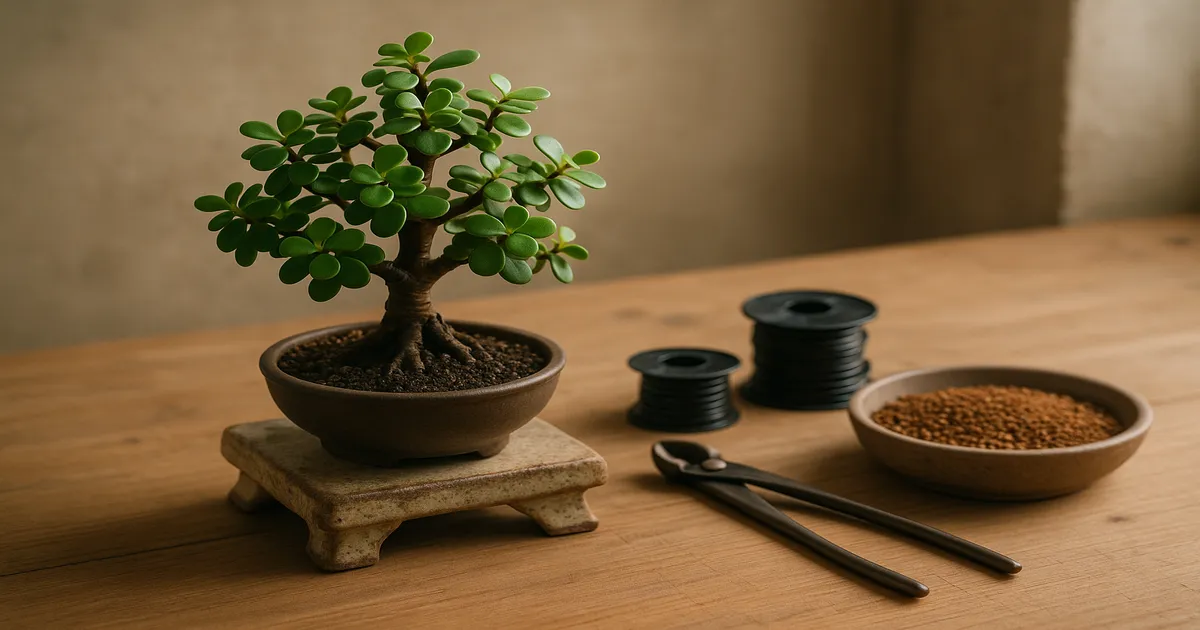
Quick Answer: Dwarf jade bonsai — almost always Portulacaria afra, not Crassula ovata — thrives with 6+ hours of bright light, a fast-draining 1:1:1 akadama/pumice/lava rock soil mix, and a soak-and-dry watering approach. Keep it above 32°F (0°C), prune regularly to encourage ramification, and you’ll have a rewarding, forgiving bonsai that improves with every season.
Learning how to care for a dwarf jade bonsai is one of the best entry points into the hobby. This species is tough, fast-growing, and responds beautifully to bonsai techniques. But before diving into care specifics, there’s an important identity question to settle.
What Is a Dwarf Jade Bonsai?
When someone says “dwarf jade bonsai,” they almost always mean Portulacaria afra — also known as Elephant Bush or Elephant Food. It’s a succulent shrub native to South Africa that develops thick, corky trunks, small rounded leaves on reddish stems, and naturally short internodes that make it ideal for miniaturization.
Don’t confuse it with Crassula ovata, the “true jade” or money tree. Both get sold under the jade bonsai label, but they belong to different plant families and have meaningfully different care needs and bonsai potential.
Dwarf Jade vs. True Jade: Which Species Do You Have?
P. afra belongs to the family Didiereaceae. In the wild across South Africa’s Eastern Cape and KwaZulu-Natal, it grows into a sprawling shrub or small tree reaching 6–15 feet (1.8–4.6 m), browsed heavily by elephants and kudus. That natural resilience to aggressive defoliation translates directly to bonsai practice — this plant handles hard pruning without complaint.
Crassula ovata is from the family Crassulaceae — a completely different lineage. It has larger, thicker leaves, a more upright and rigid growth habit, slower ramification, and branches that are more prone to snapping when wired. It can be trained as bonsai, but most practitioners find it less rewarding than P. afra.
| Feature | Portulacaria afra | Crassula ovata |
|---|---|---|
| Leaf size | Small, ~½ inch, round | Larger, ~1–2 inch, oval |
| Stem color | Reddish-brown | Green to gray |
| Branch flexibility | High when young | Lower, more brittle |
| Internode length | Short | Longer |
| Ramification speed | Fast | Slow |
Popular Cultivars for Bonsai
- Standard P. afra: Green leaves, reddish stems — the most vigorous and widely used form.
- P. afra ‘Variegata’ (Rainbow Bush): Cream, yellow, and green variegation. Striking but slower growing and slightly more cold-sensitive.
- P. afra ‘Prostrata’: A trailing, low-growing form well suited to cascade (Kengai) and semi-cascade (Han-Kengai) styles.
How to Care for a Dwarf Jade Bonsai: Light and Temperature
How Much Light Does It Need?
Portulacaria afra is a sun-lover. Outdoors, aim for at least 6 hours of direct sunlight daily. In climates that regularly exceed 100°F (38°C), some afternoon shade prevents leaf scorch — but otherwise, more sun means stronger growth, shorter internodes, and better ramification.
Indoors, the minimum is around 2,000–3,000 lux, but 5,000–10,000+ lux is where this species really performs. Anything less and you’ll see the telltale signs of etiolation: stretched, pale, weak growth with long internodes that undermine the bonsai aesthetic.
A south-facing window is the gold standard in the Northern Hemisphere; west-facing is the next best option. If natural light falls short, a full-spectrum LED grow light positioned 6–12 inches (15–30 cm) above the canopy and running 12–16 hours per day will fill the gap effectively.
Outdoor Growing
Moving your dwarf jade outdoors for summer is one of the best things you can do for it. Natural sun, air movement, and temperature fluctuation produce noticeably stronger, more compact growth than indoor cultivation alone. Wait until nighttime temperatures consistently stay above 50°F (10°C) before making the move.
Acclimate gradually. Even though this species loves sun, moving it straight from a winter windowsill into full outdoor sun will cause sunburn. Spend 10–14 days transitioning — start with a few hours of morning sun and increase exposure daily.
Temperature and Frost Protection
The optimal range is 65–95°F (18–35°C). P. afra can survive brief dips to around 28–30°F (-2°C) at the absolute minimum, but sustained frost causes cellular damage and can kill the plant. If frost is forecast, bring it inside.
In winter, keep your tree away from heating vents and radiators. Dry heat causes rapid soil desiccation and can trigger leaf drop almost as fast as overwatering. A bright, cool room at 55–65°F (13–18°C) is ideal — slightly cooler temperatures mimic natural dormancy cues and are genuinely beneficial.
By USDA zone:
- Zones 10–12: Year-round outdoor growing is possible.
- Zones 8–9: Outdoors in summer; bring in or protect when temperatures drop below 40°F (4°C).
- Zones 7 and below: Treat as a strictly indoor or greenhouse plant during cold months.
Soil, Watering, and Fertilizing
The Best Soil Mix for Dwarf Jade Bonsai
Drainage is the single most important factor. Portulacaria afra is highly susceptible to root rot in moisture-retentive soil, so standard potting mix, peat-based blends, and most garden-center cactus mixes are off the table.
The recommended mix is 1:1:1 akadama, pumice, and lava rock at a particle size of 3–6mm (⅛–¼ inch). Akadama provides structure and some water retention; pumice delivers drainage and root oxygenation; lava rock adds aeration and long-term stability. A quality pre-blended option works well here (Bonsai Jack Succulent and Cactus Soil Gritty Mix #111). Note that akadama breaks down over 2–3 years, which is one reason timely repotting matters.
If the premium mix isn’t accessible, a workable alternative is 50% coarse perlite, 25% coarse sand, and 25% small bark chips or decomposed granite. It’s not quite as good, but it drains well and won’t break the bank.
Watering: The Soak-and-Dry Method
Water thoroughly — until water flows freely from the drainage holes — then wait. Don’t water again until the soil has dried out almost completely. The chopstick test is reliable: push a wooden skewer 1–2 inches into the soil. If it comes out with soil particles clinging to it, wait. If it comes out clean and dry, it’s time to water.
Seasonal schedule:
- Spring and summer: Every 2–5 days, depending on pot size, temperature, and light.
- Fall: Gradually reduce frequency as growth slows.
- Winter: Every 10–21 days. Err toward underwatering — low light means slow evaporation, and wet soil in winter is a fast track to root rot.
Room-temperature water is ideal. If your tap water is heavily chlorinated, let it sit overnight or use collected rainwater. Water from above to ensure even saturation — misting is not a substitute for proper soil watering.
Overwatering signs: soft or translucent leaves, yellowing foliage, stems turning soft or gray-brown, soil staying wet for more than 7–10 days during the growing season.
Underwatering signs: shriveled or wrinkled leaves, loss of glossy appearance, browning leaf edges, a very lightweight pot when lifted.
The good news: P. afra recovers from underwatering quickly — a thorough watering usually reverses symptoms within 24–48 hours. Root rot from overwatering is far more dangerous and harder to fix.
Fertilizing
Feed during spring and summer with a balanced or slightly nitrogen-heavy fertilizer. A slow-release granular fertilizer applied monthly, or a liquid fertilizer at half strength every two weeks, both work well. Withhold fertilizer entirely in winter when growth slows.
Pruning Your Dwarf Jade Bonsai
Maintenance Pruning
Maintenance pruning can happen year-round during the active growing season — spring through early fall. Once a shoot has extended 2–4 nodes beyond the canopy edge, cut it back just above a leaf node or lateral branch. Each cut tip responds by producing 2–4 new shoots, multiplying your branch count with every session. Over time, this is how you build the fine ramification that defines a mature bonsai.
Use sharp, clean scissors or concave cutters and remove crossing branches, downward-growing shoots, and anything that disrupts the design.
Structural Pruning and Trunk Chops
Structural pruning is best done in late winter to early spring (February–March in the Northern Hemisphere), just before the main growth flush. Wounds heal fastest when new growth is pushing.
Trunk chops are particularly effective with P. afra. Cut the trunk to the desired height and new growth will emerge vigorously from below — it’s one of the fastest ways to develop taper and a more dramatic nebari. Apply cut paste to any wound larger than ¼ inch (6mm) in diameter to prevent desiccation and reduce infection risk.
Branch selection principles:
- Primary branches should emerge from the lower third of the trunk and extend outward and slightly downward.
- Avoid bar branches — two branches emerging directly opposite each other at the same height look unnatural.
- Choose branches that show taper: thicker at the base, tapering toward the tip.
Full defoliation is not recommended for P. afra. The plant stores significant energy in its leaves, and stripping them all at once causes unnecessary stress. Partial defoliation of the densest areas to improve light penetration is fine.
Wiring and Styling
Always use aluminum wire for P. afra — never copper. Aluminum is softer and far less likely to damage the succulent bark. Wire diameter should be roughly one-third the diameter of the branch being wired.
Practical gauge guidelines:
- Very fine twigs (under 3mm): 1.0–1.5mm
- Small branches (3–6mm): 1.5–2.0mm
- Medium branches (6–12mm): 2.5–3.0mm
- Large branches (12mm+): 3.5–4.0mm or use guy wires
Apply wire at a 45-degree angle in smooth, even coils. The best windows for wiring are late winter to early spring or after summer growth has slightly hardened. Check wired branches every 3–4 weeks during the growing season — P. afra grows fast and wire bites into bark surprisingly quickly. When removing wire, always cut it off in sections rather than unwinding it. Unwinding risks snapping branches, especially on older wood.
Suitable styles: Informal upright (Moyogi) is the most natural fit. Slanting (Shakan) works well. Cascade and semi-cascade styles suit the ‘Prostrata’ cultivar especially. Forest and group plantings are also excellent — P. afra’s fast growth and fine ramification make it ideal for multi-tree compositions.
Repotting Dwarf Jade Bonsai
Repot young, developing trees every 2–3 years; mature specimens every 3–5 years. Clear signals it’s time: roots circling the pot interior, roots emerging from drainage holes, or water pooling on the surface instead of draining quickly. Even if roots look fine, akadama breaks down after 2–3 years, so degraded soil structure alone is reason enough to refresh.
The best time is early spring, just before the main growth flush.
Step-by-step:
- Remove the tree carefully and comb out the roots with a root hook .
- Prune up to one-third of the root mass — remove circling roots, dead roots, and any mushy sections.
- Prepare fresh soil mix and clean the pot (or use a new one).
- Position the tree, wire it into the pot through the drainage holes if needed, and work fresh soil in around the roots.
- Water thoroughly until water runs freely from the drainage holes.
Keep the tree in bright but indirect light for 2–3 weeks after repotting. Hold fertilizer for 4–6 weeks to avoid burning freshly pruned roots.
Common Problems
Leaf Drop
Overwatering and underwatering can both trigger leaf drop — check soil moisture to distinguish them. Sudden environmental changes (moving indoors to outdoors, cold drafts, light shifts) also cause temporary shedding as the tree adjusts. Some seasonal loss of inner leaves is completely normal. Cold stress is a serious cause: if temperatures dropped near or below freezing, bring the tree inside, reduce watering, and give it time to recover.
Root Rot
Root rot is the most dangerous problem for dwarf jade bonsai, and it’s almost always caused by overwatering combined with poor drainage. If you suspect it, unpot the tree, trim away all mushy brown roots, dust the cuts with a fungicide powder, and repot into fresh, dry soil. Withhold water for about a week to let root cuts callus before resuming careful watering.
Pests
- Mealybugs: White cottony clusters at branch junctions. Treat small infestations with isopropyl alcohol on a cotton swab, or neem oil for larger ones.
- Spider mites: Fine webbing on foliage, especially in dry indoor conditions. Treat with insecticidal soap and increase airflow.
- Scale: Brown bumps on stems that don’t wipe off easily. Remove manually with a soft brush dipped in isopropyl alcohol, or apply a systemic insecticide for severe infestations.
Frequently Asked Questions
How often should I water my dwarf jade bonsai? During spring and summer, every 2–5 days is typical, but always let the soil dry out almost completely between waterings. In winter, cut back to every 10–21 days. Pot size, temperature, and light levels all affect the exact frequency — use the chopstick test rather than a fixed schedule.
Can dwarf jade bonsai live indoors permanently? Yes, but it needs the brightest spot you can provide — ideally a south-facing window with 5,000+ lux. Without adequate light, growth becomes etiolated and the tree weakens over time. A quality grow light can compensate if natural light is insufficient.
When is the best time to repot a dwarf jade bonsai? Early spring, just before the main growth flush begins. This gives the tree the entire growing season to recover and establish new roots.
Why is my dwarf jade bonsai dropping leaves? The most common causes are overwatering, underwatering, cold stress, or a sudden change in environment. Check soil moisture first. If the soil is wet and has been for more than a week, ease off watering and check the roots for rot. If the soil is bone dry, water thoroughly and symptoms should reverse within 24–48 hours.
Can I use regular cactus soil for my dwarf jade bonsai? Most commercial cactus mixes retain too much moisture for bonsai use, where the small pot volume and restricted root space make drainage even more critical. A purpose-blended inorganic mix — akadama, pumice, and lava rock in equal parts — is strongly preferred. If that’s not available, cut commercial cactus mix with at least 50% coarse perlite to improve drainage.