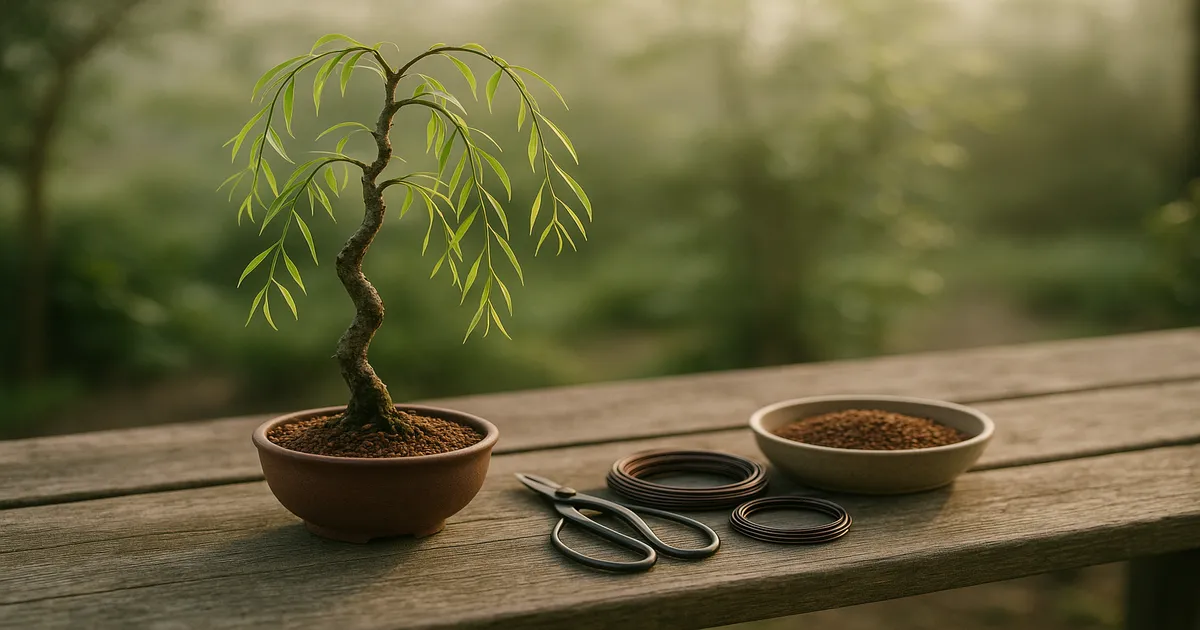
Quick Answer: Growing a bonsai willow tree means managing one of the fastest, thirstiest species in the hobby. Willows need full outdoor sun, near-daily watering in summer, and genuine cold dormancy in winter. Get those three things right and you’ll have a dramatic, rewarding tree — get them wrong and the tree declines fast.
Willow bonsai are genuinely exciting to grow — the weeping silhouette, the rapid development, the early-spring catkins on certain species — but they’re also unforgiving if you treat them like a typical bonsai. Learning how to grow a bonsai willow tree properly means understanding its natural habitat first: riverbanks, floodplains, and wetland edges. That context explains almost every care decision you’ll make.
How to Grow a Bonsai Willow Tree: At a Glance
What Makes Willow Bonsai Unique?
Three things set willows apart from most bonsai species:
- Extraordinary water demand — among the thirstiest of all bonsai, often requiring watering twice daily in peak summer.
- Exceptionally fast growth — new shoots extend 4–6 leaves in a matter of weeks, demanding pruning every 2–4 weeks during the growing season.
- Mandatory outdoor dormancy — willows kept indoors year-round weaken progressively and typically fail within 2–3 years.
Key Care Requirements
| Factor | Requirement |
|---|---|
| Light | 6–10 hours direct sun daily |
| Water | Once or twice daily in summer; check every 7–10 days in dormancy |
| Soil | 50% akadama / 30% pumice / 20% lava rock |
| Temperature (growing) | 65–85°F (18–29°C) |
| Temperature (winter storage) | 25–45°F (−4–7°C) |
| Pruning frequency | Every 2–4 weeks (maintenance); late winter (structural) |
| Wiring material | Aluminum strongly preferred over copper |
Best Willow Species for Bonsai
Salix babylonica – Classic Weeping Willow
The iconic choice. S. babylonica produces the long, pendulous branches most people picture when they think “willow.” It’s a vigorous grower best suited to medium and large bonsai where the sweeping habit has room to express itself. Hardy to Zones 6–9, tolerating temperatures down to around 0°F (−18°C).
Salix matsudana ‘Tortuosa’ – Corkscrew Willow
The twisted, contorted branching gives instant visual movement without heavy wiring — a real advantage. It’s also tougher than babylonica, handling temperatures down to −20°F (−29°C) in Zones 4–8. A great pick for colder climates or anyone who wants dramatic structure without fighting straight branches into shape.
Salix integra ‘Hakuro-nishiki’ – Dappled Willow
This one stands out for its variegated pink, white, and green foliage — especially striking on new spring growth. It has a naturally compact habit and small leaves that suit bonsai scale well. Hardy to Zones 4–9, it works beautifully at smaller sizes and is one of the most ornamentally distinctive willows you can style.
Salix caprea and Salix gracilistyla – Pussy Willow Varieties
Both are prized for their seasonal display before the leaves even appear. S. caprea (Goat Willow) produces familiar silver-white catkins; S. gracilistyla goes further with striking pink-red catkins in late winter. Both are cold-hardy to Zone 4 and more compact than the classic weeping willow — excellent for growers who want a strong seasonal moment in their display.
Salix repens – Best for Shohin and Mame Scales
If you want a miniature willow bonsai, S. repens is the one to reach for. Its naturally dwarf, low-growing habit means you’re working with a species that wants to stay small rather than fighting a vigorous tree into a tiny pot. Hardy to Zone 4, it’s also one of the more forgiving willows for beginners working at small scale.
Light and Temperature for Willow Bonsai
Willows Must Be Kept Outdoors
This isn’t a preference — it’s a requirement. Willow bonsai need genuine winter dormancy to stay healthy long-term. Trees kept indoors year-round look fine for a season or two, then gradually weaken, become pest-prone, and eventually decline. Short indoor display periods of one to two weeks are fine during the growing season, but permanent indoor cultivation will fail.
How Much Sun Does a Willow Bonsai Need?
Aim for a minimum of 6 hours of direct sun daily, with 8–10 hours preferred from April through September. Willows grown in partial shade survive but produce elongated, weak internodes, pale foliage, and reduced vigor — all problems that undermine bonsai quality. Morning sun is preferable to afternoon sun when you can’t offer a full day of exposure.
Heat Tolerance and Summer Shade
Most willows handle up to 100°F (38°C) with adequate water, but container roots are more vulnerable to heat than in-ground trees. In climates where afternoon temperatures regularly exceed 95°F (35°C), move your tree to a spot with afternoon shade after 2:00–3:00 PM and keep a close eye on soil moisture — it will dry out faster than you expect.
Cold Hardiness and the Container Zone Penalty
Here’s something many growers overlook: containerized roots are exposed to cold air on all sides, making them roughly one hardiness zone more vulnerable than the same tree in the ground. A willow rated hardy to Zone 5 in-ground may suffer root damage at Zone 6 temperatures in a pot. Always protect one zone warmer than the species’ stated ground rating.
Winter Storage
The sweet spot for winter storage is 25–45°F (−4–7°C) — cold enough to maintain dormancy, warm enough to protect roots from freezing solid.
Good options:
- Unheated garage or shed
- Cold greenhouse or polytunnel
- Cold frame with an insulating cover on severe nights
- Against a sheltered south-facing wall with mulch around the pot
Avoid:
- Heated spaces above 50°F (10°C) — these break dormancy prematurely
- Exposed, windy locations — desiccating winter winds cause branch dieback even when temperatures are acceptable
Check soil moisture every 2–3 weeks during dormancy. Willows can desiccate even without leaves.
Soil and Watering: Managing the Willow’s Thirst
Moisture-Loving Yet Drainage-Dependent
Willows need more consistent moisture than almost any other bonsai, yet they still require a free-draining substrate. Waterlogged soil kills roots just as surely as drought does — it just takes longer and is harder to diagnose. The goal is a mix that retains moisture longer than a typical bonsai substrate while still draining completely within a few seconds of watering.
Recommended Soil Mix
Standard willow mix: 50% akadama / 30% pumice / 20% lava rock
This is richer in akadama than a typical juniper or pine mix, reflecting the willow’s greater moisture needs. The pumice and lava rock keep things free-draining so roots never sit in standing water. Good-quality akadama makes a real difference here — Japanese-sourced akadama holds moisture and structure better than cheaper alternatives.
Beginner alternative: 60% akadama / 40% pumice — simpler to source and works well.
Avoid pure garden soil, peat-heavy mixes, or anything that doesn’t drain freely within 2–3 seconds. Target a pH of 6.0–7.0; akadama-based mixes naturally fall in this range.
How Often to Water
During peak summer growth, once or twice daily is not unusual for trees in full sun. The key rule: water thoroughly when the top ½ inch (1.2 cm) of soil begins to dry. Unlike most bonsai, you should not let willows dry out fully between waterings.
In dormancy, pull back significantly — check every 7–10 days and water lightly only if the soil is dry 1 inch (2.5 cm) below the surface.
The Double-Watering Technique
Water until it flows freely from all drainage holes, wait 30 seconds, then water again. That second pass ensures the entire root zone is saturated, not just the top layer. Single watering often leaves dry pockets in the middle of the root ball — a particular problem with akadama-heavy mixes that can form a slight crust on the surface.
Signs of Overwatering vs. Underwatering
| Overwatering | Underwatering |
|---|---|
| Yellowing lower/older leaves | Crispy brown leaf edges |
| Wilting despite wet soil | Wilting with dry soil |
| Mushy or blackened roots | Brittle twigs that snap rather than bend |
| Foul odor from soil | Leaves curling inward along the midrib |
| Algae growth on soil surface | Soil pulling away from pot edges |
Pruning Your Willow Bonsai
Maintenance Pruning: Keeping Up With Fast Growth
Once new shoots have extended 4–6 leaves, cut them back to 1–2 leaves using sharp, clean bonsai scissors. Repeat every 2–4 weeks throughout the growing season (May–August). Skip a month and you’ll have a tree that’s significantly harder to bring back into shape.
For weeping varieties, allow some shoots to extend further before cutting back. Pruning too aggressively too early prevents the pendulous habit from developing.
Structural Pruning: Timing and Technique
Major branch work — removing crossing branches, reducing overall size, establishing primary structure — belongs in late winter to very early spring, just before buds begin to swell (typically February–March). This timing lets wounds start healing with the first growth flush and minimizes disease risk.
A secondary window opens in late August after the main summer growth hardens off. Avoid heavy pruning in autumn: wounds won’t heal before dormancy and are exposed to frost damage and fungal entry all winter.
Using Sacrifice Branches to Build Trunk Girth
Willows respond exceptionally well to the sacrifice branch technique. Allow one or two branches to grow completely unchecked for a full season — no pruning, no restriction. The extra photosynthetic energy dramatically accelerates trunk thickening. Once you’ve achieved the girth you’re after, remove the sacrifice branch cleanly with a concave cutter. Apply cut paste immediately to any wound larger than pencil diameter. Expect visible callus roll within 4–8 weeks of a spring cut; full closure of a 1-inch (2.5 cm) wound typically takes 2–4 years depending on tree vigor.
Wiring Willow Bonsai
Wire Gauge and Material
As a general rule, wire should be about one-third the diameter of the branch being wired:
- Primary branches: 3.0–4.0mm aluminum
- Secondary branches: 2.0–2.5mm aluminum
- Fine tertiary branches: 1.0–1.5mm aluminum
Copper wire holds a set more firmly, but willows grow fast and have relatively soft bark. The risk of copper cutting in before you notice is simply too high. Aluminum is softer, more forgiving, and entirely adequate for willow’s growth rate.
Timing and the Wire Bite Problem
Best windows for wiring:
- Late winter before leaf emergence — bare branches are visible, bark is less tender
- Early summer (June–July) after the first growth flush hardens off
Avoid:
- Active spring push (April–May) — bark is at its most vulnerable and growth is so rapid that wire bites in within weeks
Wire can cut into willow bark in as little as 3–6 weeks during the growing season. Check every wired branch every two weeks without exception. Many experienced growers wire in late winter, achieve their set over 6–10 weeks of early spring growth, and remove wire before the summer flush begins — treating it almost as a temporary shaping tool.
Always cut wire off rather than unwinding it. Cut at every bend (every 3–4 inches / 7–10 cm) and lift sections away individually. If wire has already begun to bite in, cut it away in sections and let the indentations heal naturally.
Repotting Willow Bonsai
How Often to Repot
Willows have aggressive root systems that fill a pot quickly. Young trees typically need repotting every 1–2 years; established specimens can go every 2–3 years. The test: if roots are circling the pot walls or emerging densely from drainage holes, it’s time.
Timing and Root Work
Repot in early spring, just as buds begin to swell. The tree is coming out of dormancy with strong energy for root regeneration, and the healing response is at its peak. Avoid repotting in late summer or autumn — the tree won’t have time to re-establish before dormancy.
Remove up to one-third of the total root mass in a single session. Work methodically with a root rake and sharp root scissors, removing circling roots first, then trimming the outer root ball to fit the new pot. Willows recover well from root pruning, but respecting the one-third limit keeps the tree from going into shock.
Pot Selection and Aftercare
Oval or rectangular pots with multiple drainage holes suit willows well. The pot should be slightly smaller than the previous one (or the same size if you’ve done significant root reduction) to encourage fine root development. Avoid very shallow pots until the tree is fully established — willows need root volume to support their water demands.
After repotting, keep the tree in light shade for 2–4 weeks. Resume normal watering gradually, keeping the soil consistently moist but not waterlogged. Withhold fertilizer for 4–6 weeks to avoid stressing new root tips.
Troubleshooting Common Problems
Wilting Leaves: Drought vs. Root Rot
These look similar but have opposite causes. Drought wilting comes with dry soil, crispy leaf edges, and inward leaf curl. Root rot wilting comes with wet soil, a foul smell from the substrate, and mushy roots visible if you probe the root ball. If you water a wilting willow and it doesn’t recover within a few hours, check the roots before watering again.
Leaf Scorch and Browning Edges
Brown, crispy leaf margins in summer are usually heat or low-humidity stress. Move the tree to afternoon shade, increase watering frequency, and consider placing the pot on a humidity tray. If browning continues despite adequate water, check whether the pot itself is overheating in direct sun — light-colored or glazed pots help significantly in hot climates.
Wire Scars
If you catch wire biting in early, cut it away immediately in sections and let the indentations heal. Shallow marks will fill in over 1–2 seasons. Deep wire scars are permanent. Prevention — checking every two weeks — is the only real solution. Don’t attempt to force embedded wire out; you’ll cause more damage than the scar itself.
Premature Leaf Drop or Weak Growth
Premature leaf drop in late summer or early autumn often signals insufficient dormancy the previous winter — the tree’s internal calendar is disrupted. Weak, spindly growth with pale leaves usually points to insufficient light or underfeeding. Move the tree to a sunnier position and begin a balanced fertilizer program (higher nitrogen in spring, lower nitrogen from midsummer onward).
Frequently Asked Questions
Can you grow a willow bonsai indoors? No — not long-term. Willows require genuine cold dormancy each winter. Trees kept indoors year-round typically decline within 2–3 years as their internal seasonal rhythm breaks down. Short indoor display periods of a week or two are fine, but the tree must return outdoors.
How fast does a willow bonsai grow? Very fast — faster than almost any other bonsai species. Expect new shoots to extend 4–6 leaves within a few weeks during the growing season. This rapid growth is an advantage for development but demands pruning every 2–4 weeks to maintain shape.
What is the best willow species for a beginner? Salix matsudana ‘Tortuosa’ (Corkscrew Willow) is a strong choice — it’s cold-hardy, structurally interesting without heavy wiring, and slightly more forgiving than S. babylonica. For small-scale work, Salix repens is the best option.
How do I stop my willow bonsai from drying out so fast? Use an akadama-heavy soil mix (50% or more), water with the double-watering technique, and place the pot in a spot with morning sun and afternoon shade during the hottest months. A humidity tray beneath the pot also helps moderate moisture loss.
When should I repot my willow bonsai? Early spring, just as the buds begin to swell. This is when the tree’s energy for root regeneration is highest. Young trees need repotting every 1–2 years; mature trees every 2–3 years.