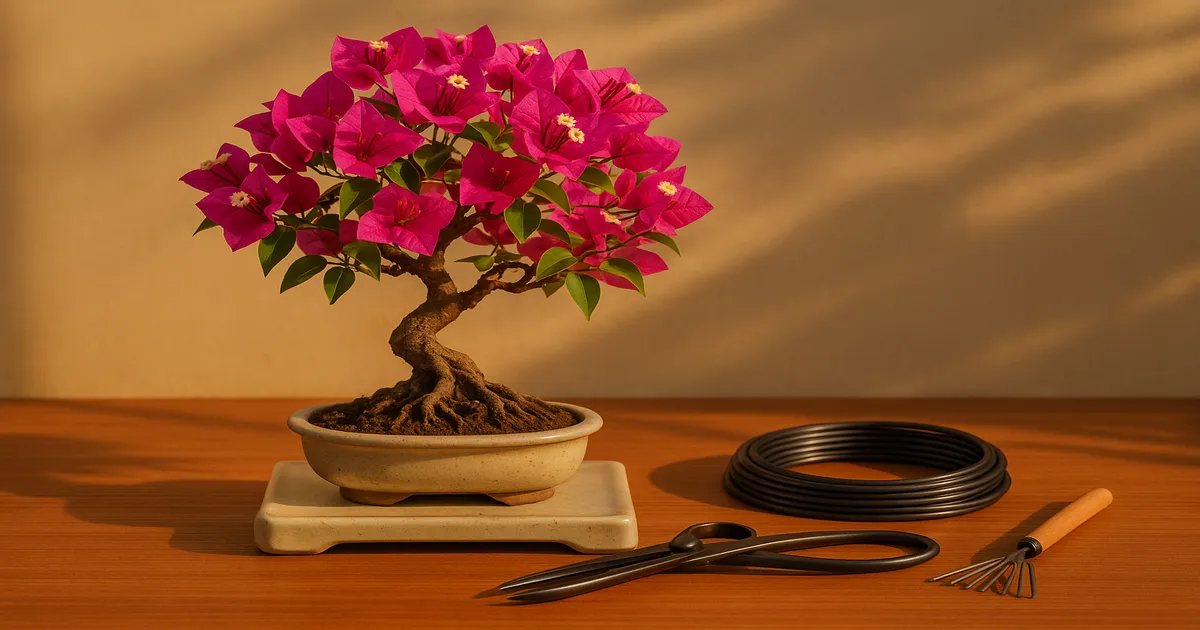
Quick Answer: To train a bougainvillea bonsai, give it 6–8+ hours of direct sun, plant it in a fast-draining inorganic mix, prune back to 2–4 nodes after each bloom flush, and use periodic drought cycles to trigger flowering. The colorful “flowers” are actually bracts — modified leaves produced on new wood — so every pruning cut sets up the next display. Bougainvillea glabra is the best species to start with.
If you’ve ever asked “how do I train this bougainvillea,” you’ve already taken the most important step: recognizing that bougainvillea isn’t a flowering shrub you can stick in a pot and hope for the best. It’s a vigorous, thorny, sun-hungry scrambler from South America’s rocky coastal slopes, and every training decision flows from that origin story. Get the environment right first. Then pruning, wiring, and repotting fall into place naturally.
Understanding Your Bougainvillea: Species and Variety Selection
What Bougainvillea’s Native Habitat Tells You
Bougainvillea evolved on well-drained, rocky slopes in Brazil, Peru, and Argentina — places with intense sun, seasonal drought, and almost no standing water. That biology is baked into the plant. It thrives on stress, not coddling. Shallow, fast-draining soil, full sun, and periodic dry spells aren’t just tolerated; they’re required.
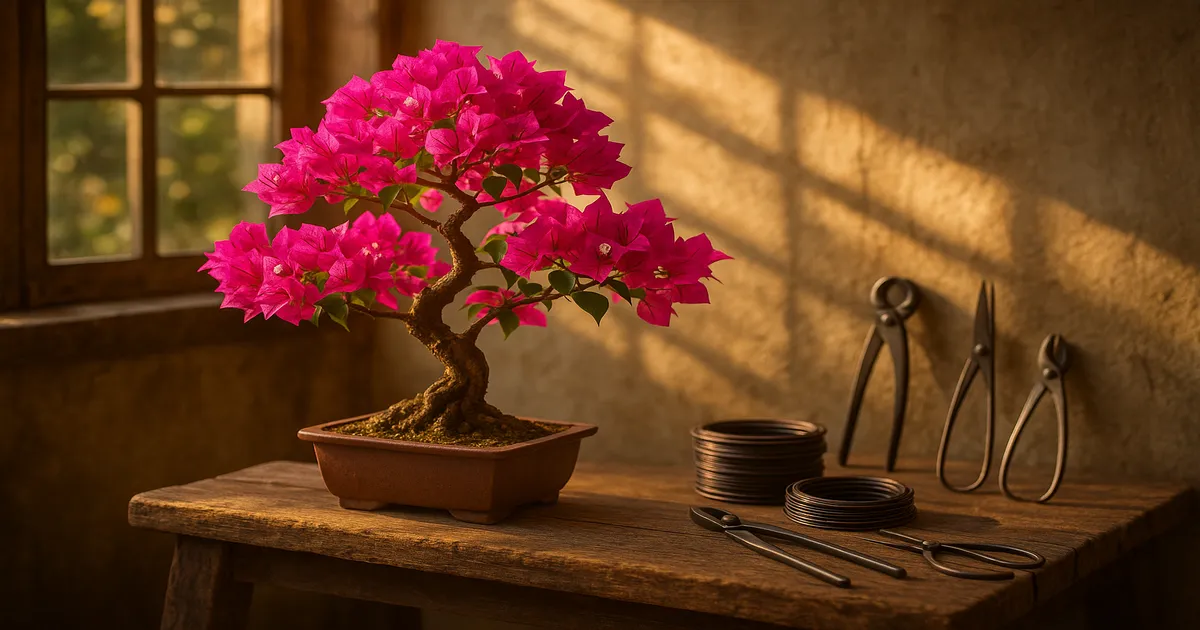
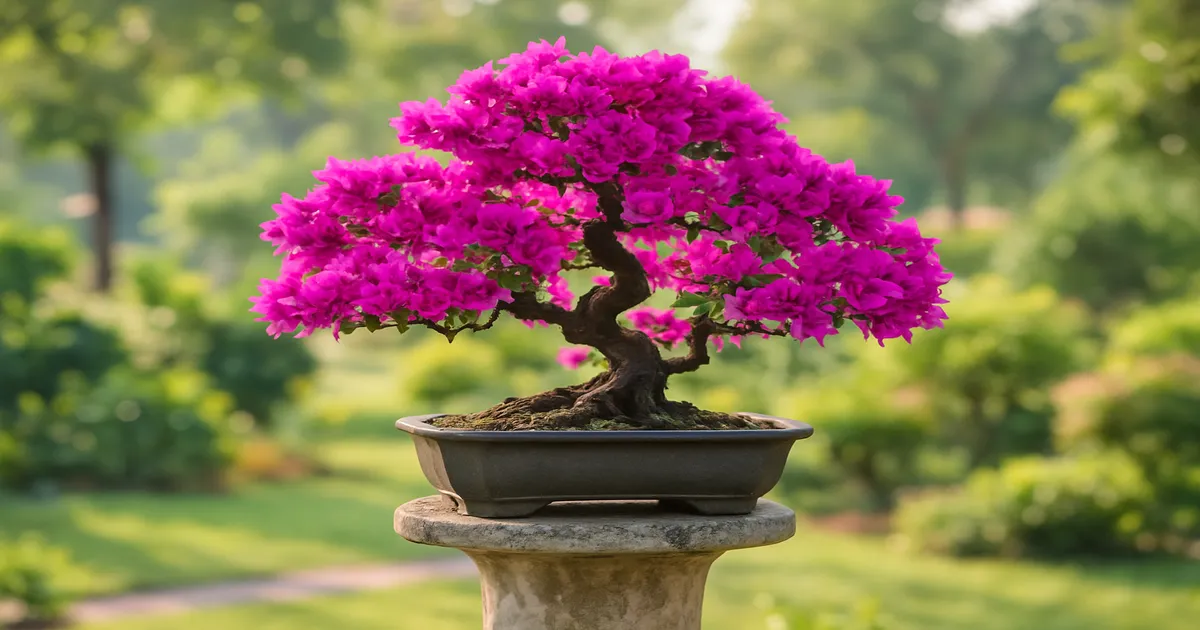
One thing to internalize before you start training: those vivid “flowers” are actually bracts — modified leaves surrounding tiny white tubular true flowers. Bract production is triggered by drought stress and high light intensity, not by fertilizing. Over-feeding a bougainvillea is one of the fastest ways to get lush green leaves and zero color.
Best Cultivars for Bonsai Training
| Cultivar | Bract Color | Bonsai Notes |
|---|---|---|
| B. glabra | Magenta/Purple | Smaller leaves, aggressive back-budding — top choice |
| B. spectabilis | Pink to Magenta | Larger leaves; better for larger bonsai sizes |
| ’Barbara Karst’ | Bright Red | Strong grower; handles hard pruning well |
| ’Helen Johnson’ (Torch Glow) | Deep Pink/Red | Naturally compact; great for smaller styles |
| ’Raspberry Ice’ | Magenta, variegated | Slower growing; striking foliage display |
| ’Rosenka’ | Gold to Pink | Color-changing bracts; novelty appeal |
| ’Singapore Pink’ | Soft Pink | Popular in tropical bonsai communities |
B. glabra wins on nearly every bonsai metric: shorter internodes, more aggressive back-budding after pruning, slightly smaller bract and leaf size, and faster trunk development. If you’re starting fresh, this is your species.
Light, Temperature, and Environment
How Much Sun Does a Bougainvillea Bonsai Really Need?
More than almost any other bonsai species. Six to eight hours of direct, unfiltered sun is the minimum for reliable blooming and compact growth. Less than that and you’ll get etiolated, weak growth and zero bracts — no matter how perfectly you prune.
Most indoor windowsills deliver only 10–20% of the light intensity of outdoor full sun. If you must grow indoors, use high-output LED grow lights (Spider Farmer SF1000 LED) positioned 6–12 inches above the canopy, running 14–16 hours per day at 2,000–5,000 foot-candles.
| Setting | Suitability | Key Consideration |
|---|---|---|
| Outdoor, full sun | Excellent | Ideal in every way |
| Outdoor, partial shade | Poor | Flowering drops sharply |
| Indoor, south window | Marginal | Supplemental lighting strongly recommended |
| Indoor, grow lights | Acceptable | Requires high-output fixtures |
| Greenhouse | Excellent | Best option in cold climates |
Cold Hardiness and Winter Care by Climate Zone
Bougainvillea handles brief dips to 32°F (0°C) but begins dropping leaves below 40°F (4°C). A hard freeze below 28°F (-2°C) can kill stems to the soil line. The shallow bonsai pot offers almost no root insulation — roots are in danger before the canopy shows any visible stress.
- Zones 9b–11: Outdoor year-round; move to a sheltered wall when temps approach 40°F (4°C)
- Zones 7–9a: Overwinter in a frost-free greenhouse or bright indoor space at a minimum of 45–50°F (7–10°C); expect leaf drop — it’s normal
- Zone 6 and below: Full indoor overwintering required; maintain at least 50°F (10°C) with supplemental lighting
Soil and Watering: Replicating a Rocky Coastal Slope in a Pot
How to Train This Bougainvillea With the Right Soil Mix
Forget standard potting soil. Bougainvillea needs near-instant drainage with just enough cation exchange capacity to hold nutrients briefly between waterings.
Base mix for most climates — 40:40:20:
- Akadama 40% — moisture retention, CEC, gradual breakdown
- Pumice 40% — drainage, aeration, air-pruning of roots
- Lava rock 20% — long-term structural stability, trace minerals
Hot/arid climates (Southwest US, Mediterranean): Shift to 50% akadama / 30% pumice / 20% lava rock for slightly more moisture retention.
Humid/tropical climates: Drop to 30% akadama / 40% pumice / 30% lava rock to prioritize drainage and reduce fungal risk.
Use 3–6mm particle size for standard bonsai pots; 1–3mm for mame. Avoid standard potting soil, peat-based mixes, and sand as a primary component — all three either compact, suffocate roots, or create pH problems over time.
Watering During the Growing Season
Water when the top ½ inch of soil begins to dry. In full sun during summer heat, that can mean watering daily or even twice daily. Always water thoroughly until water runs freely from all drainage holes. Never let the pot sit in standing water.
The Drought Cycle: Your Most Powerful Blooming Tool
When you want a bloom flush, deliberately withhold water until the leaves show a slight wilt — not severe stress, just the beginning of droop. Hold that state for 2–4 weeks, then resume normal watering. Within a few weeks, a flush of bracts follows. This directly mimics the dry-season biology of the plant’s native habitat and is far more effective than any fertilizer trick.
Overwatering vs. Underwatering: How to Tell the Difference
Overwatering signs:
- Leaves yellow and drop while still soft
- Soil stays wet 48+ hours after watering
- Mushy stem base or fungal growth on soil surface
Underwatering signs:
- Leaf edges turn brown and crispy
- Leaves curl inward before dropping
- Pot feels unusually light when lifted
Avoid misting as a humidity strategy — wet foliage overnight invites fungal disease. Bougainvillea tolerates low humidity (20–30%) far better than most tropical species.
How to Train This Bougainvillea: Pruning From Pinching to Hard Cuts
How Bougainvillea Grows — What You Need to Know Before Cutting
Bracts form on new wood — the current season’s growth. That means every pruning cut stimulates the very growth that produces the next bloom cycle. Pruning and flowering aren’t in conflict; they’re linked. The plant also has strong apical dominance, so without regular intervention, energy concentrates in the longest shoots while lower branches weaken and eventually die back.
Maintenance Pruning: Keeping the Silhouette Tight
After each bloom flush, cut new growth back to 2–4 nodes from the branch base. Make your cut at a 45-degree angle just above a node — this prevents dieback and directs the next shoot. Repeat every 4–8 weeks during the growing season. For the finest ramification, pinch soft new growth tips with your fingernails or tweezers before they harden. It’s the gentlest option and produces the tightest branching over time.
Structural Pruning: Building Branch Architecture
The best window for structural work is late winter to early spring, just as buds begin to swell. The plant is at its lowest energy demand, wounds callus quickly as temperatures rise, and you can see the branch structure clearly before new growth obscures it.
- Use sharp concave cutters for branches up to ½ inch diameter; a pull saw for anything larger
- Cut flush or slightly concave — never leave stubs, which die back and invite disease
- Eliminate branches growing directly toward or away from the viewer, crossing branches, and anything that disrupts the triangular silhouette
- Favor branches with natural movement over straight, rigid ones
Apply water-based horticultural wound paste to any cut larger than ¼ inch diameter. Avoid petroleum-based sealants — they can damage the cambium. Large wounds may take 1–3 growing seasons to fully callus, which is completely normal.
Defoliation: When and Whether to Try It
Full defoliation — removing all leaves to stimulate back-budding and reduce leaf size — is an advanced technique for healthy, vigorous trees only. Time it for early summer in warm climates. Never defoliate a stressed tree, one in its first two years of training, or one that was recently repotted. Partial defoliation (removing only the largest leaves) is a safer middle ground for intermediate growers.
Wiring Bougainvillea Bonsai: Bending Thorny Branches Safely
Aluminum is your default wire. It’s gentler on bark, easier to work with, and provides sufficient holding power for most branches. Reserve copper for thick primary branches that need stronger correction.
| Branch Diameter | Recommended Wire |
|---|---|
| Very fine (< 3mm) | 1.0–1.5mm aluminum |
| Fine (3–6mm) | 2.0–2.5mm aluminum |
| Medium (6–12mm) | 3.0–3.5mm aluminum |
| Thick (12–20mm) | 4.0–5.0mm aluminum or 2.5–3.0mm copper |
| Very thick (20mm+) | Guy wires or clamp-and-screw |
Wire diameter should be roughly one-third the diameter of the branch being wired.
The thorns complicate everything. Wear thick gloves and use needle-nose pliers to guide wire around thorns rather than forcing it through. Wrap at a consistent 45-degree angle to the branch axis, apply firm even pressure without biting in, and bend slowly. Warm older wood with your hands before attempting a significant bend. If you hear cracking, stop immediately and wrap the area with raffia — partial cracks often heal completely.
Check wire every two weeks during the growing season. Bougainvillea grows fast, and wire bites in faster than you’d expect. Remove wire by cutting — never by unwinding. Use quality wire cutters (Knipex 71 12 160) to snip at every bend, then lift sections away gently. If wire has already begun to embed, cut it into short sections and carefully peel each piece away. Pulling will tear bark.
Repotting Bougainvillea Bonsai: Roots, Timing, and Pot Selection
How Often to Repot
- Young trees in development (under 5 years): Every 1–2 years
- Established trees (5–15 years): Every 2–3 years
- Mature, refined specimens: Every 3–5 years
Don’t rely solely on a schedule. Repot when roots are circling the bottom of the pot, emerging from drainage holes, or when water runs straight through almost instantly — all signs of a root-bound tree.
Timing and Root Pruning
Early spring, just as new buds begin to swell, is the sweet spot. In warm climates there’s a secondary window immediately after a major bloom cycle in early summer. Avoid repotting during bloom, winter dormancy, or extreme heat.
- Remove the tree carefully; use a root hook or chopstick to loosen roots from pot walls
- Comb out the root mass from the bottom upward with a root hook
- Remove 50–70% of the old soil from between roots
- Trim circling or overly long roots with sharp root shears
- Repot into fresh bonsai mix; work soil between roots with a chopstick to eliminate air pockets
- Water thoroughly and move to a shaded, sheltered spot for 4–6 weeks
Unglazed clay pots are ideal — they breathe, regulate moisture, and age beautifully alongside the tree’s naturally fissured bark. Size the pot to roughly two-thirds the tree’s height for upright styles, and ensure multiple drainage holes. Avoid pots that are too deep, which hold excess moisture and undermine the fast-draining soil you’ve worked to create.
Troubleshooting Common Bougainvillea Bonsai Problems
Won’t bloom: Insufficient light is the most common culprit by a wide margin. If the tree isn’t getting 6+ hours of direct sun, no other technique will compensate. Also check whether you’ve applied a drought cycle recently, whether you’ve been over-fertilizing with nitrogen, and whether nighttime temperatures are consistently above 50°F (10°C).
Yellowing leaves: Soft yellow leaves that drop usually point to overwatering or root rot. Yellow leaves with green veins suggest iron or magnesium deficiency, often caused by pH issues. Yellowing that coincides with temperatures dropping below 50°F (10°C) is likely normal cold-season leaf drop — the tree is fine.
Leggy, stretched growth: Etiolated growth — long internodes, pale leaves, weak stems — is almost always a light problem. Pruning alone won’t fix it. Move the tree to a sunnier location first, then prune. Cutting back stretched growth in poor light just produces more stretched growth.
Pests and diseases: Bougainvillea is relatively pest-resistant, but watch for aphids on new growth (blast off with water or treat with insecticidal soap), spider mites in hot dry conditions (look for fine webbing and stippled leaves), mealybugs at leaf axils (treat with 70% isopropyl alcohol on a cotton swab), and scale on stems (scrape off manually, then treat with neem oil). Botrytis gray mold attacks spent bracts in high humidity above 70% — improve airflow and remove spent material promptly.
Recovering a neglected tree: Stabilize the environment before resuming any training. Move to full sun, correct the watering regime, and let the tree push several flushes of new growth. Once it’s clearly healthy and vigorous — typically one full growing season — resume pruning, wiring, and repotting on a normal schedule. Trying to train a struggling tree accelerates its decline.
Frequently Asked Questions About Training Bougainvillea Bonsai
How do I train this bougainvillea to bloom more reliably?
Place the tree in 6–8+ hours of direct sun and apply a deliberate drought cycle: withhold water until leaves show a slight wilt, maintain that for 2–4 weeks, then resume normal watering. A bloom flush typically follows within 2–4 weeks. Repeat after each flush throughout the growing season. Avoid high-nitrogen fertilizers during this period — they push foliage at the expense of bracts.
How do I train this bougainvillea into a specific bonsai style?
Start with structural pruning in late winter or early spring before new growth emerges. Select your primary branches, remove everything that conflicts with your intended silhouette, and wire the remaining branches into position. Informal upright and slanting styles suit bougainvillea’s naturally arching growth habit best. Cascade styles are possible but require more aggressive wiring and a tall pot to accommodate the downward movement.
When is the best time to repot a bougainvillea bonsai?
Early spring, just as buds begin to swell, is ideal. The tree has full energy reserves and wounds heal quickly as temperatures rise. In warm climates, there’s a secondary window immediately after a major bloom flush in early summer. Avoid repotting during active bloom, winter dormancy, or heat waves above 95°F (35°C).
Why are my bougainvillea’s leaves dropping after repotting?
Some leaf drop after repotting is completely normal — the tree is redirecting energy to root regeneration. Keep it in partial shade, reduce watering slightly, and withhold fertilizer for 4–6 weeks. As long as the stems remain green and flexible, the tree is recovering. New growth should appear within 3–6 weeks in warm conditions.
Can I grow a bougainvillea bonsai indoors permanently?
It’s possible but genuinely difficult. Bougainvillea needs more light than almost any indoor environment can naturally provide. If you commit to high-output LED grow lights running 14–16 hours per day and maintain temperatures above 60°F (15°C) year-round, you can keep the tree alive and occasionally blooming. Most growers find it far easier to move the tree outdoors for spring through autumn and bring it inside only for frost protection.