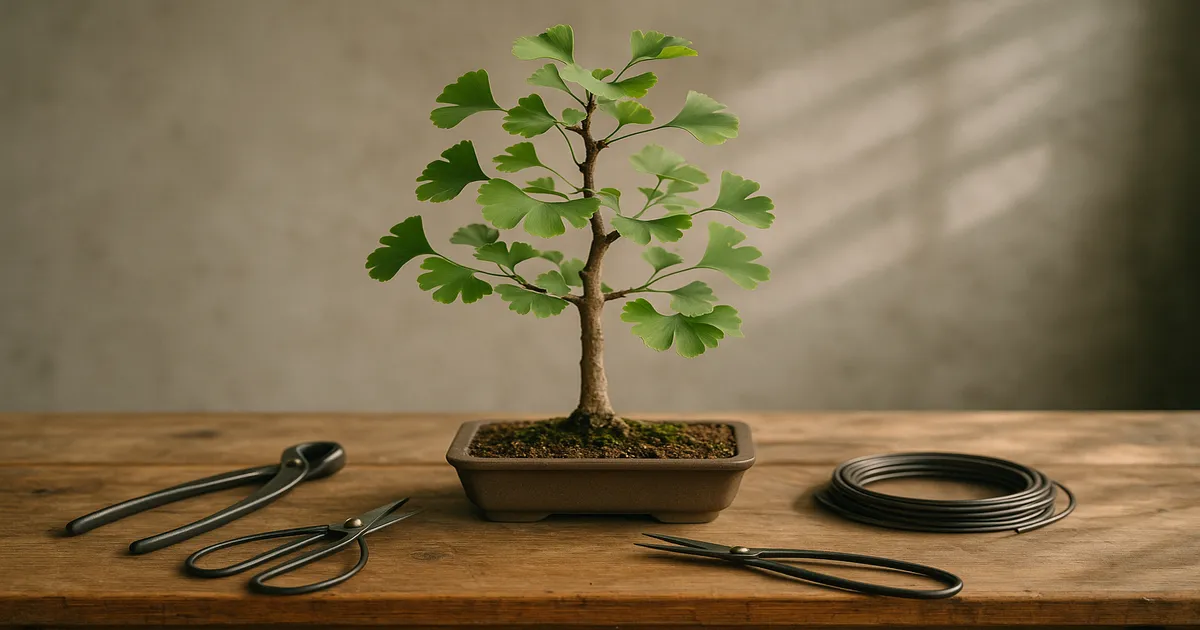
Quick Answer: Prune a ginkgo bonsai in two phases — maintenance pruning in late spring to early summer (cutting long shoots back to 1–2 leaves once they reach 3–5 leaves) and structural pruning in late winter dormancy before buds swell. The real key is understanding the difference between fast-growing long shoots and slow-growing spur shoots. The good news: ginkgo backbuds readily on old wood, making it one of the more forgiving species for beginners.
Knowing how to prune a ginkgo bonsai correctly transforms a sprawling, awkward tree into something genuinely stunning — dense clusters of fan-shaped leaves on short spur shoots, brilliant gold in autumn, and a sense of ancient calm. But ginkgo has a unique growth system that trips up beginners who treat it like any other deciduous tree. Get the timing and technique right, and this living fossil practically rewards you.
Understanding Ginkgo Growth Before You Cut
Long Shoots vs. Spur Shoots
Ginkgo produces two completely different shoot types, and your entire pruning strategy depends on understanding them. Long shoots (auxiblasts) extend rapidly — sometimes 12–24 inches in a single season — and drive the tree’s overall spread. Spur shoots (brachyblasts) grow just 1–2 mm per year and carry those beautiful clusters of fan-shaped leaves.
Bonsai aesthetics depend almost entirely on spur shoot development. Your job is to control long shoot extension while encouraging the tree to invest energy into building dense, leafy spur clusters.
Apical Dominance
Ginkgo has strong apical dominance — upper branches naturally outcompete lower ones for energy. Left unchecked, the top grows increasingly vigorous while lower branches weaken and eventually die. The fix is deliberate but simple: cut upper branches harder and leave lower branches longer. This redirects energy downward and keeps the whole tree in balance.
Why Ginkgo Forgives Hard Cuts
When you cut a branch back hard, ginkgo reliably pushes new buds from dormant growth points along old wood — even on thick, aged branches. This makes it far more forgiving than species like juniper or azalea, where a mistimed hard cut can mean permanent die-back. If you make a structural mistake, the tree will usually give you a second chance.
How to Prune a Ginkgo Bonsai: Maintenance Cuts
Timing
The primary maintenance window opens in late spring to early summer, once the first flush of long shoots has hardened off — leaves fully expanded, darkened in color, and the shoot carrying 3–5 leaves. This is your main pruning moment.
A secondary window runs through midsummer (July–August in the Northern Hemisphere) to catch any second flush. Avoid pruning after late August; growth stimulated that late won’t harden before frost. Never prune during or immediately after bud break — the tree is running on stored reserves and doesn’t need extra stress.
Cutting Back Long Shoots
- Let the new long shoot extend to 3–5 leaves (roughly 2–4 inches / 5–10 cm)
- Cut back to 1–2 leaves using sharp bonsai scissors (Masakuni 8003) or concave cutters
- Make the cut at a 45-degree angle just above a leaf node so water sheds cleanly
- Repeat as new extension growth emerges through the season
- On weak branches, let long shoots extend a little further before cutting — this builds vigor before you ask the branch to ramify
Managing Spur Shoots
Spur shoots mostly take care of themselves. Their growth rate is so slow they rarely need cutting. If a cluster becomes crowded or blocks interior light, remove the entire spur at its base rather than cutting partway — a partial cut leaves an awkward stub and does nothing for the structure. Thinning crowded clusters keeps light reaching the inner branches, which is what keeps them alive and budding.
Defoliation for Leaf Size Reduction
Full defoliation — removing every leaf in early June — is a powerful tool for reducing leaf size and increasing ramification. The second flush that follows typically comes back noticeably smaller. It’s genuinely stressful, though, so follow these rules:
- Timing: Early June only, so the second flush has time to harden before autumn
- Frequency: No more than once every 2–3 years on the same tree
- Partial defoliation (upper and outer canopy only, leaving inner and lower leaves) is gentler and can be done annually on healthy trees
- Never defoliate a stressed tree, a recently repotted tree, or any tree in its first 2–3 years of training
How to Prune a Ginkgo Bonsai: Structural Cuts
Best Time for Structural Pruning
Late winter dormancy — January through March, before any bud swell — is the ideal window. The branch structure is fully visible without leaves, metabolic activity is at its lowest, and the entire growing season lies ahead for wound healing. Sap flow hasn’t started, so cuts bleed minimally.
In mild climates, immediately after leaf drop in autumn (October–November) is a workable secondary option, giving wounds a chance to begin callusing before hard freezes arrive.
Which Branches to Remove First
Work through a clear priority order rather than making random cuts:
- Dead, diseased, or crossing branches
- Water shoots (growing straight up) and downward-growing branches
- Branches growing directly toward the viewer
- Bar branches — pairs growing directly opposite each other at the same height
Once you’ve cleared the obvious problems, step back and assess the overall structure before cutting anything else.
Branch Spacing and Placement
Branches should be distributed with increasing spacing toward the apex — roughly 20–30% more space between each successive branch as you move up the trunk. Ideally they alternate left, right, and back as they ascend, creating a natural three-dimensional canopy. Avoid keeping any branch thicker than one-third the trunk diameter at its attachment point — it will look grafted-on rather than grown. Lower branches are the hardest to replace, so when in doubt, leave them.
Cutting Technique and Wound Care
Use concave cutters (Kaneshin No.2) for branches up to 1 inch (2.5 cm) in diameter, and a pull saw for anything larger. Aim for a slightly concave wound — it calluses more neatly than a flush or convex cut. Apply cut paste to any wound larger than a pencil in diameter.
Ginkgo calluses more slowly than most deciduous species. Large wounds may take 3–5 years to close fully — that’s completely normal. Keep the tree in optimal health and resist the urge to reopen wounds trying to speed things up.
Soil, Watering, and Feeding
Soil Mix
A well-draining, particle-based mix is non-negotiable. Ginkgo roots are susceptible to Phytophthora and other water molds in compacted or waterlogged soil.
Standard mix: 40–50% akadama, 25–30% pumice, 20–30% lava rock (Bonsai Jack Gritty Mix)
- Hot, dry climates: Increase akadama to 50–60% for better moisture retention
- Cool, humid climates: Reduce akadama to 30–35% and increase pumice and lava rock for sharper drainage
- Particle size: 3–6 mm for most trees; 1–3 mm for shohin and mame
- Always sieve out fine dust — it compacts over time and chokes drainage
Watering
During the growing season, water thoroughly when the top 0.5–1 inch of soil approaches dryness — in warm weather that often means daily, sometimes twice daily. Water until it flows freely from every drainage hole. The lift test is your best guide: a dry pot is noticeably lighter than a watered one. During dormancy, water just enough to keep the root mass from desiccating completely — roughly every 2–3 weeks, barely moist.
Fertilising Around Pruning
Use a balanced fertiliser throughout active growth. After structural pruning in late winter, begin feeding as soon as buds start to swell in spring. Switch to a low-nitrogen fertiliser in late summer to harden new growth before cold arrives — soft, lush growth heading into winter is vulnerable to frost damage.
Seasonal Care and Winter Protection
Ginkgo is strictly an outdoor bonsai. It needs genuine seasonal dormancy — something an indoor environment cannot provide. Aim for 6–10 hours of direct sun daily during the growing season. In climates where summer temperatures regularly exceed 95°F (35°C), 30–40% shade cloth in the afternoon prevents leaf scorch.
The ideal overwintering temperature is 25–45°F (-4–7°C). An unheated garage, shed, or cold frame works well for most growers. The critical threshold is 20°F (-7°C) — below that, pot-grown roots face serious freeze risk. Wrap pots in burlap or bubble wrap, or sink them into the ground surrounded by mulch. In USDA Zones 9–10, the tree may not receive enough natural chilling hours; 8–12 weeks in a refrigerator at 35–45°F (2–7°C) can substitute.
Move the tree back outdoors gradually when nighttime temperatures reliably stay above 28°F (-2°C). Protect emerging buds from any late frost below 26°F (-3°C) — a single hard frost at the wrong moment can wipe out the entire spring flush.
Troubleshooting Common Problems
Yellowing leaves starting at the base of the canopy and working upward is a classic overwatering signal. Check the roots — healthy roots are white to tan and firm; roots damaged by Phytophthora will be dark, mushy, and may smell foul. Repot immediately into fresh, well-draining soil and reduce watering frequency.
Brown, crispy leaf margins usually mean underwatering, low humidity, or heat stress. Check soil moisture first. In hot climates, afternoon shade and a humidity tray can make a real difference.
Poor backbudding after pruning almost always means the tree was already stressed before you cut. Ginkgo backbuds reliably on healthy, well-fed trees with adequate light. Get the basics right before attempting hard structural cuts.
Slow wound closure is normal for ginkgo, not a warning sign. Apply cut paste, keep the tree healthy, and give it time. A wound the diameter of your thumb may take 3–5 years to close fully.
Premature autumn color or early leaf drop outside normal seasonal timing is worth investigating promptly — it usually signals drought stress, root damage, or disease.
Frequently Asked Questions
When is the best time to prune a ginkgo bonsai?
For maintenance pruning, the best window is late spring to early summer, once the first flush of new shoots has produced 3–5 leaves and hardened off. For structural pruning, late winter dormancy (January–March) before bud swell is ideal — the branch structure is fully visible and the whole growing season lies ahead for healing.
Can you defoliate a ginkgo bonsai to reduce leaf size?
Yes, and it works well — but only on vigorous, healthy trees. Full defoliation in early June prompts a second flush that typically comes back noticeably smaller. Limit full defoliation to once every 2–3 years. Never defoliate a recently repotted tree, a stressed tree, or any tree in its first few years of training.
How do you encourage spur shoot development?
Consistently cutting long shoots back to 1–2 leaves redirects energy into spur shoot development over time. Adequate light — at least 6–8 hours of direct sun daily — is equally important, since spur shoots won’t thrive in shade. Balanced fertilising through the growing season gives the tree the resources to build and maintain those dense leaf clusters.
How long does it take for pruning wounds to heal?
Ginkgo calluses more slowly than most deciduous bonsai species. Small cuts may close within a season or two. Larger structural wounds can take 3–5 years or more. Apply cut paste to all significant wounds, keep the tree in excellent health, and be patient — there’s no reliable shortcut.
Should I prune my ginkgo bonsai in winter or summer?
Both, for different purposes. Late winter dormancy is best for structural work — removing or reshaping major branches when the architecture is clearly visible. Late spring to early summer is best for maintenance pruning — controlling long shoot extension and refining the canopy. Using both windows gives you the most control over the tree’s development.