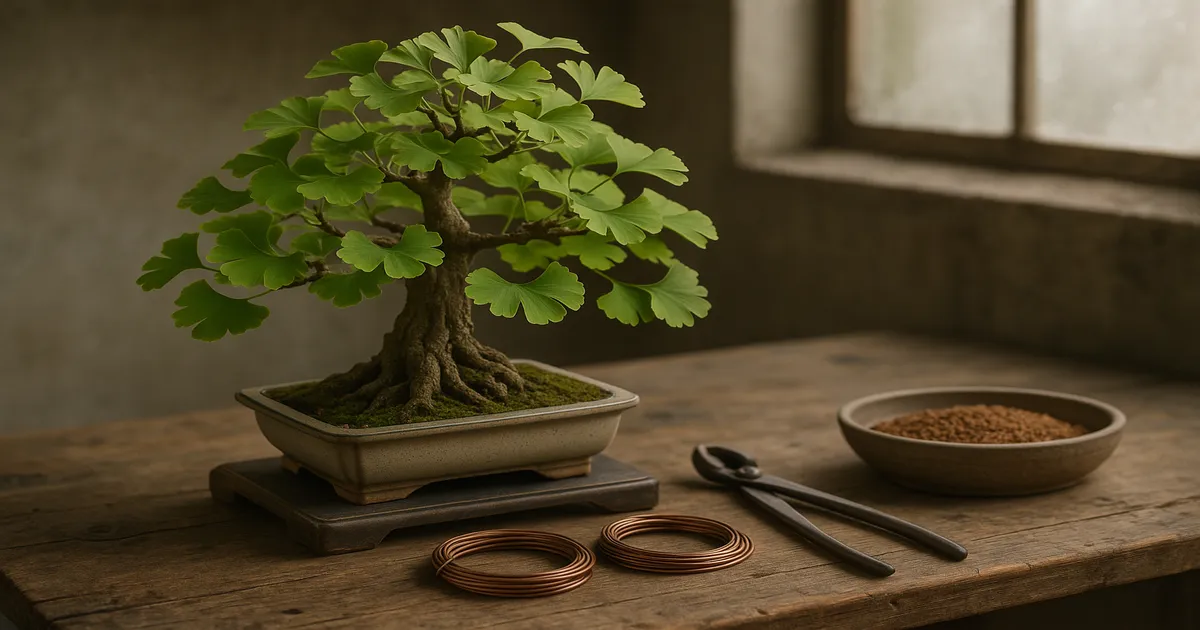
Quick Answer: To bonsai a ginkgo tree, grow it outdoors year-round in full sun, plant it in a well-draining inorganic mix (50% akadama, 30% pumice, 20% lava rock), and allow true winter dormancy. Throughout the growing season, prune long extension shoots back to 2–3 leaves to encourage the dense spur growth that gives mature ginkgo bonsai their character. Dwarf cultivars like ‘Troll’ and ‘Mariken’ are the easiest starting point for beginners. Expect a long, rewarding journey — ginkgo bonsai develop slowly but age with extraordinary grace.
How to Bonsai a Ginkgo Tree: Species Overview and Best Cultivars
The Living Fossil
Ginkgo biloba is genuinely ancient — its lineage stretches back over 270 million years, predating the dinosaurs. It’s the sole surviving member of the division Ginkgophyta, with no close living relatives. Wild populations in China’s Zhejiang and Guizhou provinces are critically rare, yet the species has thrived in cultivation for over 1,000 years, planted at Buddhist and Shinto temples across China and Japan. Some of those temple specimens are estimated to be 2,000–3,000 years old.
That history matters for bonsai. When you work with ginkgo, you’re working with a tree that has the biological capacity to outlive everything around it.
Distinctive Aesthetic Qualities
The fan-shaped leaves with their central notch are instantly recognizable and unlike any other deciduous tree. In autumn, the foliage turns a uniform, luminous golden-yellow before dropping — often within just one or two weeks — creating one of the most dramatic seasonal displays in bonsai. The trunk develops beautiful grey, furrowed bark with age, and older trees can produce unusual woody aerial protrusions called chichi that add extraordinary character.
Best Cultivars for Ginkgo Bonsai
The straight species works well, especially from nursery stock, but cultivars offer real advantages:
- ‘Troll’ — Extremely compact, globose dwarf with very short internodes. A top choice for shohin and mame formats.
- ‘Mariken’ — Pendulous, naturally compact habit with tight internodes. Excellent for smaller work.
- ‘Chi Chi’ — Develops the distinctive chichi woody protrusions on older trunks. A favourite among collectors.
- ‘Jade Butterflies’ — Compact growth with distinctively shaped leaves; popular in North American bonsai circles.
- ‘Pendula’ — Weeping branch structure suited to cascade and semi-cascade styles.
- ‘Fastigiata’ — Columnar, upright form useful for formal upright (chokkan) development.
For beginners, ‘Troll’ or ‘Mariken’ are the clearest starting points — their naturally compact growth does much of the hard work for you.
Male vs. Female Trees
Ginkgo is dioecious — trees are either male or female. Female trees produce fleshy seeds coated in butyric acid, which smells strongly of rancid butter. For bonsai purposes, always choose male trees. Named cultivars propagated vegetatively are reliably male, which is another strong reason to choose cultivars over random seedlings.
Light, Temperature, and Outdoor Placement
Why Ginkgo Must Live Outdoors
This is non-negotiable. Ginkgo requires genuine winter dormancy triggered by cold temperatures and a shortening photoperiod. Keeping one as a permanent indoor bonsai leads to progressive decline and death within 2–5 years. You can bring it inside briefly during peak autumn colour, but it must go back out.
Aim for at least 6–8 hours of direct sun daily during spring and summer. More sun means more compact internodal growth and better ramification. Where summer temperatures regularly exceed 95°F (35°C), some afternoon shade prevents leaf scorch.
Temperature Tolerances
Ginkgo is hardy in USDA Zones 3–9 in the ground, surviving to around -20°F (-29°C). In a container, that hardiness drops significantly — the root ball is exposed to ambient air rather than insulating soil. Protect containerised bonsai when temperatures are expected to fall below 15°F (-9°C) for extended periods. The ideal winter storage range is 25–40°F (-4–4°C): cold enough to maintain dormancy, but not so cold that the root ball freezes solid repeatedly.
Winter Protection Options
- Cold frame or unheated greenhouse — The gold standard. Maintains near-freezing temperatures without hard freezes.
- Unheated garage or shed — Effective in Zones 5–7. Check soil moisture monthly.
- Mulching around the pot — In Zones 7–9, place the pot on the ground and mulch around (not over) it for insulation.
- Pot wrapping — Wrap the pot (not the tree) with frost cloth or bubble wrap during short cold snaps.
Never store a dormant ginkgo in a heated space. Temperatures above 50°F (10°C) in winter break dormancy prematurely, burning energy reserves before spring arrives.
Soil, Watering, and Feeding
The Right Soil Mix for Ginkgo Bonsai
Use an inorganic mix: 50% akadama, 30% pumice, 20% lava rock. Akadama retains moisture and supports fine root development; pumice improves drainage; lava rock adds long-term structural stability. Target a soil pH of 6.0–7.0. Avoid standard potting soil, peat-based mixes, or anything organic-heavy — these compact over time, retain too much moisture, and invite root rot.
Climate adjustments:
- Hot, dry climates: 40% akadama, 35% pumice, 25% lava rock
- Cool, humid climates: 60% akadama, 25% pumice, 15% lava rock
Use particle sizes of 3–9mm for standard bonsai, and 3–6mm for shohin and mame.
Watering Through the Seasons
- Spring and summer: Water when the top ½–1 inch of soil begins to dry. Small pots in hot weather may need watering daily or twice daily.
- Autumn: Reduce frequency as growth slows. Allow slightly more drying between waterings.
- Winter: Water sparingly — every 2–4 weeks, just enough to prevent the root ball from desiccating completely. A chopstick inserted into the soil is the most reliable moisture check.
Always water thoroughly until water flows freely from the drainage holes. Shallow watering encourages weak surface roots and salt buildup in the lower soil profile. Rainwater is ideal; if using tap water, let it sit 24 hours to off-gas chlorine. Hard water gradually raises soil pH — flush the soil thoroughly every few weeks or switch to collected rainwater.
Fertilising
Feed with a balanced fertiliser (equal NPK) through spring and early summer to support growth. Shift to a low-nitrogen, high-phosphorus and potassium feed from midsummer onward to harden growth and support root development before dormancy. Slow-release organic pellets work well as a base feed; liquid fertiliser can supplement during peak growth. Hold off on feeding for 3–4 weeks after repotting.
How to Prune a Ginkgo Bonsai
Understanding Ginkgo’s Two Shoot Types
Ginkgo produces two distinct shoot types. Long shoots (auxiblasts) extend rapidly and build trunk girth and primary branch structure. Short spur shoots (brachyblasts) grow slowly from long shoots and carry clusters of leaves at their tips — these are what give mature ginkgo bonsai their dense, refined foliage pads. Your goal is to control long shoot extension while encouraging brachyblast development throughout the canopy.
Maintenance Pruning
Once a long shoot has extended 4–6 leaves, cut it back to 2–3 leaves. Use sharp scissors rather than finger-pinching — the fan-shaped leaves tear easily, and clean cuts prevent dieback. Repeat throughout spring and early summer. Over time, this repeated cutting stimulates lateral bud development and eventual spur shoot formation.
Defoliation
Full or partial defoliation in early summer (late June in the Northern Hemisphere) can reduce leaf size, increase ramification, and intensify autumn colour. Only defoliate healthy, vigorous trees — never a weak tree or one repotted in the same season. New, smaller leaves typically emerge within 3–4 weeks. Partial defoliation — removing leaves from the strongest areas while leaving weaker zones intact — is a useful way to balance vigour across the canopy without stressing the whole tree.
Structural Pruning
The best time for structural pruning is late winter, just before bud swell. The tree is fully dormant, structure is clearly visible, and the upcoming growing season drives rapid wound healing. Late spring, after the first flush hardens off, is a secondary window. Avoid heavy pruning in late summer or autumn — wounds won’t callus before dormancy.
When selecting branches to remove, eliminate those growing directly toward or away from the viewer, any crossing branches, and anything with reverse taper. Preserve branches with natural movement and existing brachyblast clusters — these represent years of development. Always cut just outside the branch collar using concave cutters. Apply cut paste to any wound larger than ¼ inch (6mm) in diameter.
Wiring Ginkgo Bonsai
Aluminum wire is the right choice for most ginkgo work — it’s softer, easier to apply, and less likely to damage ginkgo’s relatively thin bark. Use wire roughly one-third the diameter of the branch: 1.0–1.5mm for fine ramification, 2.0–3.5mm for small to medium branches, and 4.0–6.0mm aluminum (or copper one gauge smaller) for primary branches.
Wire in early spring before bud break, or in late spring after the first flush hardens. Autumn wiring works for branches needing long-term repositioning — wire applied then can remain through dormancy into the following season. Never wire immediately after repotting; wait at least 4–6 weeks.
Application tips:
- Anchor wire around the trunk or a larger branch before proceeding to the target branch.
- Wire two adjacent branches of similar thickness with one wire for efficiency and better hold.
- Maintain a 45-degree wrapping angle — steeper angles provide less support; shallower angles cut in faster.
- Wire should be snug but not biting. You should just be able to slide a fingernail between wire and bark.
Check wired branches every 2–3 weeks during the growing season. Remove wire by cutting it in sections — never unwind it from a set branch, as this risks snapping brittle wood. Wire scars on ginkgo can take years to fade.
Repotting Ginkgo Bonsai
Repot in early spring, just as buds begin to swell — before any leaf emergence. Repotting too early risks cold damage to disturbed roots; repotting after leaf-out forces the tree to support new foliage while recovering from root work.
- Young, developing trees: Every 2–3 years
- Established specimens: Every 3–5 years
Also repot when roots are circling the pot base, water drains very slowly, or soil dries out unusually fast. Akadama breaks down over 2–3 years, so replace the mix on schedule even if the tree looks healthy.
Remove up to one-third of the root mass. Cut cleanly — torn roots invite rot. Healthy roots are firm and white to tan; trim any that are dark, mushy, or excessively long. After repotting, place the tree in a sheltered, semi-shaded spot for 4–6 weeks. Water carefully and hold off on fertiliser for the first 3–4 weeks.
Troubleshooting Common Problems
Yellowing leaves outside autumn — Almost always overwatering or root rot. Check roots and drainage. Pale, washed-out new growth can indicate nitrogen deficiency; address with a balanced feed.
Premature leaf drop — Usually stress: drought, overwatering, root rot, or heat. Check soil moisture first — both extremes trigger early leaf drop. Sudden drop after moving the tree may simply be adjustment to a new light environment.
Leggy growth and poor ramification — A pruning strategy problem. If you’re not cutting long shoots back to 2–3 leaves consistently, energy stays in extension shoots and brachyblasts never develop. Revisit maintenance pruning frequency.
Pests — Ginkgo is notably pest-resistant. Aphids occasionally appear on new spring growth; treat with insecticidal soap or a strong water jet. Spider mites are more common in hot, dry conditions — look for fine webbing and stippled leaves, increase humidity, and treat with neem oil if needed. Scale insects appear at branch junctions; treat with horticultural oil. Root rot is the primary disease concern and is caused by poor drainage, not a specific pathogen — prevention through proper soil mix is far easier than treatment.
Failure to thrive after winter — A tree that leafs out weakly in spring usually desiccated during dormancy or was stored somewhere too warm and broke dormancy prematurely. Rehabilitate by placing it in a sheltered outdoor spot with filtered light, water carefully, and hold off on pruning or repotting until the tree shows clear signs of recovery.
Frequently Asked Questions: How to Bonsai a Ginkgo Tree
Can ginkgo bonsai be kept indoors? No. Ginkgo requires genuine winter dormancy and cannot survive as a permanent indoor bonsai. It will decline and die within 2–5 years without a proper cold rest period. You can bring it inside briefly during peak autumn colour, but it must return outdoors before temperatures warm.
How fast does a ginkgo bonsai grow? Slowly, especially in a container. Expect modest annual extension — typically 6–12 inches on long shoots during the growing season, depending on pot size, feeding, and cultivar. Dwarf cultivars like ‘Troll’ grow even more slowly. This is part of what makes ginkgo bonsai so rewarding over the long term: the tree ages gracefully and develops character that faster-growing species simply can’t replicate.
When does a ginkgo bonsai turn yellow in autumn? Typically in October to November in the Northern Hemisphere, depending on your climate. The colour change is triggered by shortening days and cooling temperatures. Full sun exposure through autumn intensifies and prolongs the display. The drop is often sudden — many ginkgo trees shed most of their leaves within a single week.
How do I reduce leaf size on my ginkgo bonsai? Consistent maintenance pruning (cutting long shoots back to 2–3 leaves throughout spring and summer), full sun exposure, and controlled feeding all contribute to smaller leaves over time. Defoliation in early summer on a healthy, vigorous tree is the most direct technique — new leaves that emerge are noticeably smaller. Dwarf cultivars also have inherently smaller leaves than the straight species.
Is ginkgo bonsai suitable for beginners? Yes, with the right cultivar and realistic expectations. Ginkgo is pest-resistant, tolerates hard pruning, and is forgiving of minor care mistakes. The main beginner pitfall is attempting to grow it indoors or failing to provide adequate winter dormancy. Start with ‘Troll’ or ‘Mariken’, keep it outdoors, and focus on consistent maintenance pruning — the tree will reward your patience.